Why Supply Chains Are Rapidly Adopting Modern Traceability
July 17, 2025
Traditional traceability has been driven by two forces:
- Regulatory pressure by bureaucracy which is interested more in ticking check boxes than utilizing public funds to deliver value to the society
- Internal political pressure in supply chains to provide visibility to white collars on what actually happens in the day-to-day operations driven by blue collar field workers
Countless number of mega-scale fraud being exposed despite of the presence of ‘perfect data records’ has proven traditional traceability worth next to nothing. COVID has cemented the fact that the ultimate survival for supply chains lies in the strong relationships built through all tiers via authentic information sharing. Even the regulators are leaning today towards looking at traceability as a means of promoting better democracy throughout supply chains. The upcoming regulation on ‘Digital Passport’ by the European Commission is arguably the best contemporary example for this.
When we at Tracified started our journey a decade ago, supporting supply chains to implement digital traceability, we thought that bringing in authenticity to the data records was the decisive bridge from traditional traceability to its modern counterpart. While it has been verified to be instrumental in rediscovering traceability as a practice to implement value communication in supply chains, the experience in implementing our blockchain based solution in multiple countries repetitively showed that the real need is to bring in a whole new array of capabilities to all types of supply chain participants. One thing of particular importance is that these new capabilities must empower participants of every grade equally, attacking the biggest factor that hindered achieving any kind of useful traceability: power asymmetry between supply chain organizations.
Here we summarize our insights in implementing traceability in supply chains spanning multiple domains, scales, complexities, cultures, value systems and trust structures. (Please right click and open it as an image to view the text clearly).
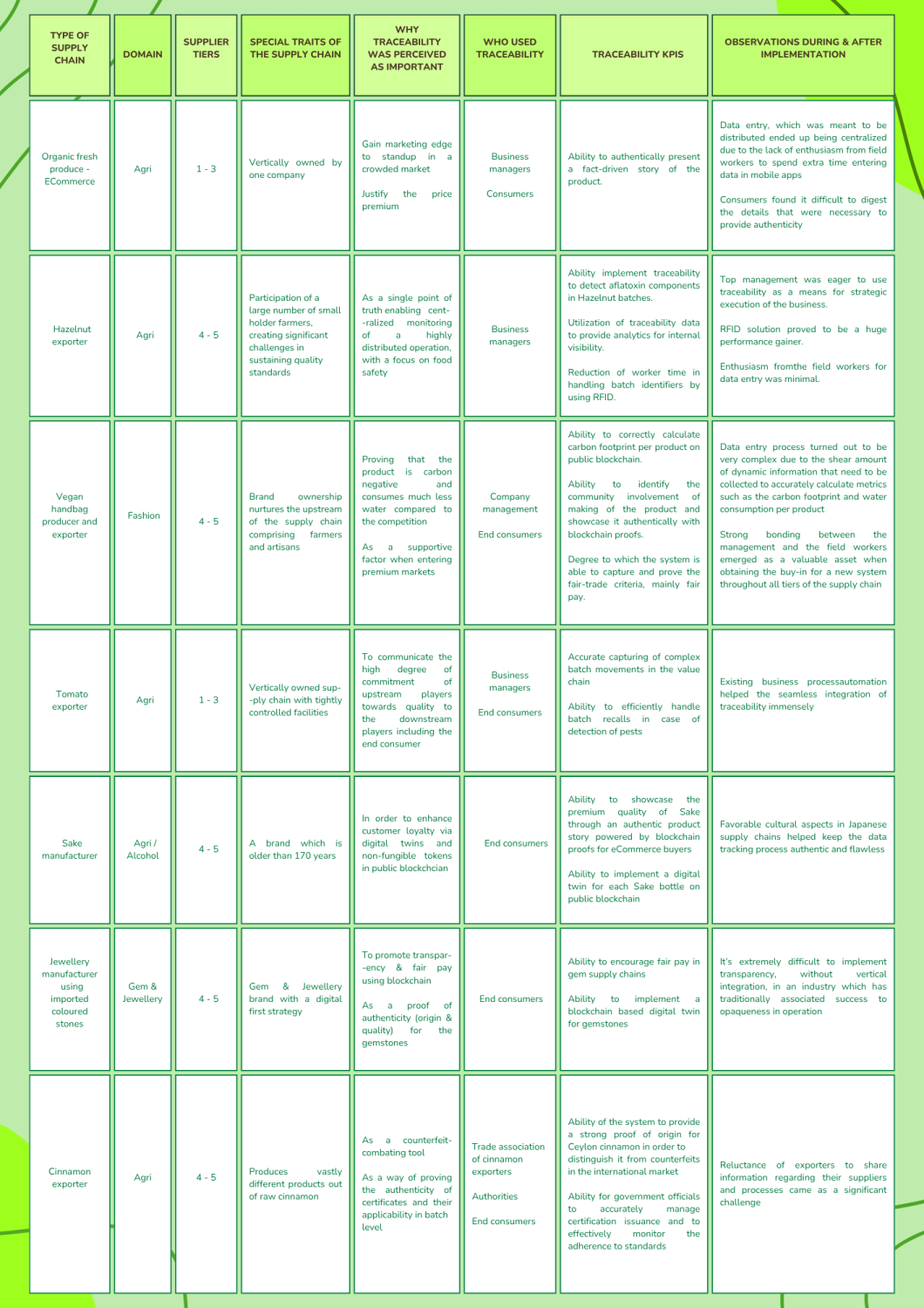
In summary :
- Just like with democracy, there’s a multitude of expectations from traceability in different contexts and groups, yet the key for success is promoting equality and widespread participation.
- Traceability must not be one solution, but an umbrella of applications. Off-the-shelf SaaS solutions lack the ability to serve the breadth of disparate user needs, emphasizing that it’s time for traceability implementers to utilize the capabilities of Generative AI to carve out a tailor-made solution for everyone at low cost.
- Expecting people to spend time entering tracking data belongs to the old world; the new mandate is utilizing AI to automatically extract them from already existing sources.
- Bringing in transparency into supply chain domains where opaqueness was deemed a competitive advantage requires new incentive structures driven by blockchain. For this the industry needs to invent the parallel of the disruption blockchain has already brought into the financial world.
Traceability is undoubtedly the new currency for supply chains, driving efficiency, authenticity and participation through transparency.